

Research and Innovation

AI Advances Inclusivity: UNDIRA Informatics Engineering Lecturer Collaborates Across Universities to Develop ColorMate


 By :
By : 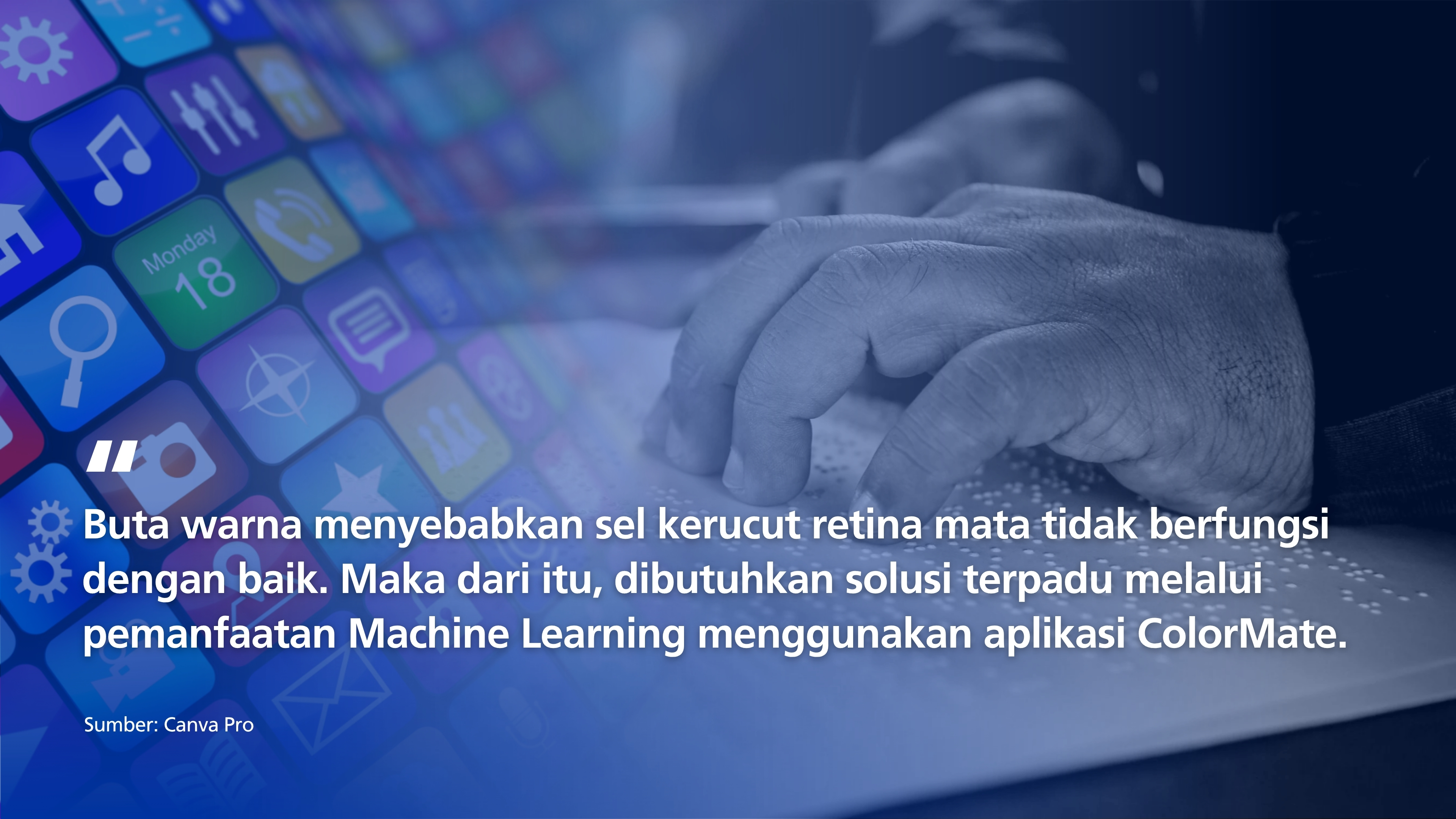
The rapid advancement of artificial intelligence (AI) continues to create opportunities for innovations that extend beyond efficiency, placing greater emphasis on accessibility and inclusivity.
One of the growing challenges faced by society today is colour vision deficiency (CVD), commonly known as colour blindness. This condition occurs when the cone cells in the retina do not function properly or are affected by congenital abnormalities, making it difficult for individuals to distinguish certain colours.
In Indonesia, data from the 2007 Basic Health Research (Riset Kesehatan Dasar/Riskesdas) reported that approximately 7.4% of the population experienced colour vision deficiency, with the highest prevalence recorded in the Special Capital Region of Jakarta at 24.3%. Despite these figures, continued nationwide data collection, dedicated support, and accessible assistive technologies for people with colour vision deficiency remain relatively limited.
Recognizing the need to foster a more inclusive ecosystem, a team of researchers developed ColorMate, a mobile application designed to improve colour accessibility. According to Anita Ratnasari, M.Kom., one of the researchers involved in the project, ColorMate is the result of a collaborative initiative involving lecturers and researchers from multiple universities.
Rather than being developed solely as a technical application, ColorMate was designed as a practical solution to assist users with everyday tasks that require accurate colour recognition.
From a technical perspective, ColorMate was developed using Android Studio with the Kotlin programming language. The development process followed a structured software engineering lifecycle, including requirements analysis, system design, implementation, comprehensive testing of both the user interface and application functionality—from login to logout—using the black-box testing method to ensure compliance with system specifications, followed by continuous maintenance.
The application utilizes a smartphone's camera to capture images, which are then processed using the K-Means Clustering algorithm to identify the dominant colour within the visual data. The detection results are presented as the colour name, RGB (Red, Green, Blue) values, a confidence level, and a user-friendly colour description to help users better understand the output.
Beyond colour detection, ColorMate also features an interactive quiz that provides users with an initial indication of the possible type of colour vision deficiency based on their responses. This educational component enhances the application's value by enabling users not only to identify colours more accurately but also to gain a better understanding of their visual condition. However, the quiz is intended solely as a preliminary screening tool and should not be considered a substitute for professional medical diagnosis.
To support data management, the application integrates Firebase Authentication and Firebase Firestore, enabling secure user authentication while automatically storing colour detection history and quiz results. This integration allows users to revisit their previous records at any time, making the application more organized, accessible, and supportive of independent learning and self-monitoring.
Despite its promising capabilities, ColorMate still offers opportunities for further enhancement. Colour detection accuracy may be influenced by environmental lighting conditions, smartphone camera quality, and the limitations of the application's colour database. Future development may therefore focus on implementing lighting normalization techniques, expanding the colour database, and introducing a camera focus-lock feature to improve the consistency and stability of colour identification.
ColorMate demonstrates how artificial intelligence and machine learning can be applied to address real-world social challenges in meaningful ways. Through cross-university research collaboration, innovations like this are expected to inspire the academic community of UNDIRA's Informatics Engineering Study Program and partner institutions to continue producing research that is practical, human-centered, and capable of delivering tangible benefits to society.
The collaborative development of ColorMate also highlights that digital innovation should not be confined to technical excellence alone. Technology can serve as a powerful tool for expanding accessibility, promoting user independence, and building a more inclusive digital ecosystem that benefits people from all walks of life.
Source of References:
Alomedika - Kajian Jumlah Penyandang Buta Warna
Press Contact :
Biro Humas & Sekretariat Universitas Dian Nusantara
Facebook : www.facebook.com/undiraofficial
Instagram : www.instagram.com/undiraofficial
Twitter : www.twitter.com/undiraofficial
www.undira.ac.id
Other
.jpg)
Utilization of Environmentally Friendly Materials in Soil Reinforcement: Is It Feasible? Insights from UNDIRA Civil Engineering Research
Read more
Strengthening UNDIRA's Relationship: The Meaning and Benefits of Halal Bihalal
Read more
Doing Part As A Nation's Hero: Upholding the Spirit of Patriotism in Preserving Indonesia In Spirit of National Heroes Day
Read more
Campus Tanjung Duren
Jln. Tanjung Duren Barat II No. 1
Grogol, Jakarta Barat. 11470
Campus Green Ville
JIn. Mangga XIV No. 3
Campus Cibubur
Jln. Rawa Dolar 65
Jatiranggon Kec. Jatisampurna, Bekasi. 17432
Campus Cibubur Kranggan Raya
Jln. Raya Kranggan, No.6, RT 006/ RW 008
Jatiranggon Kec. Jatisampurna, Bekasi. 17432


