

Research and Innovation

One Accessibility for All: UNDIRA Lecturer Assesses User Satisfaction of SLiMS 9 Information Management System via the End-User Computing Method


 By :
By : 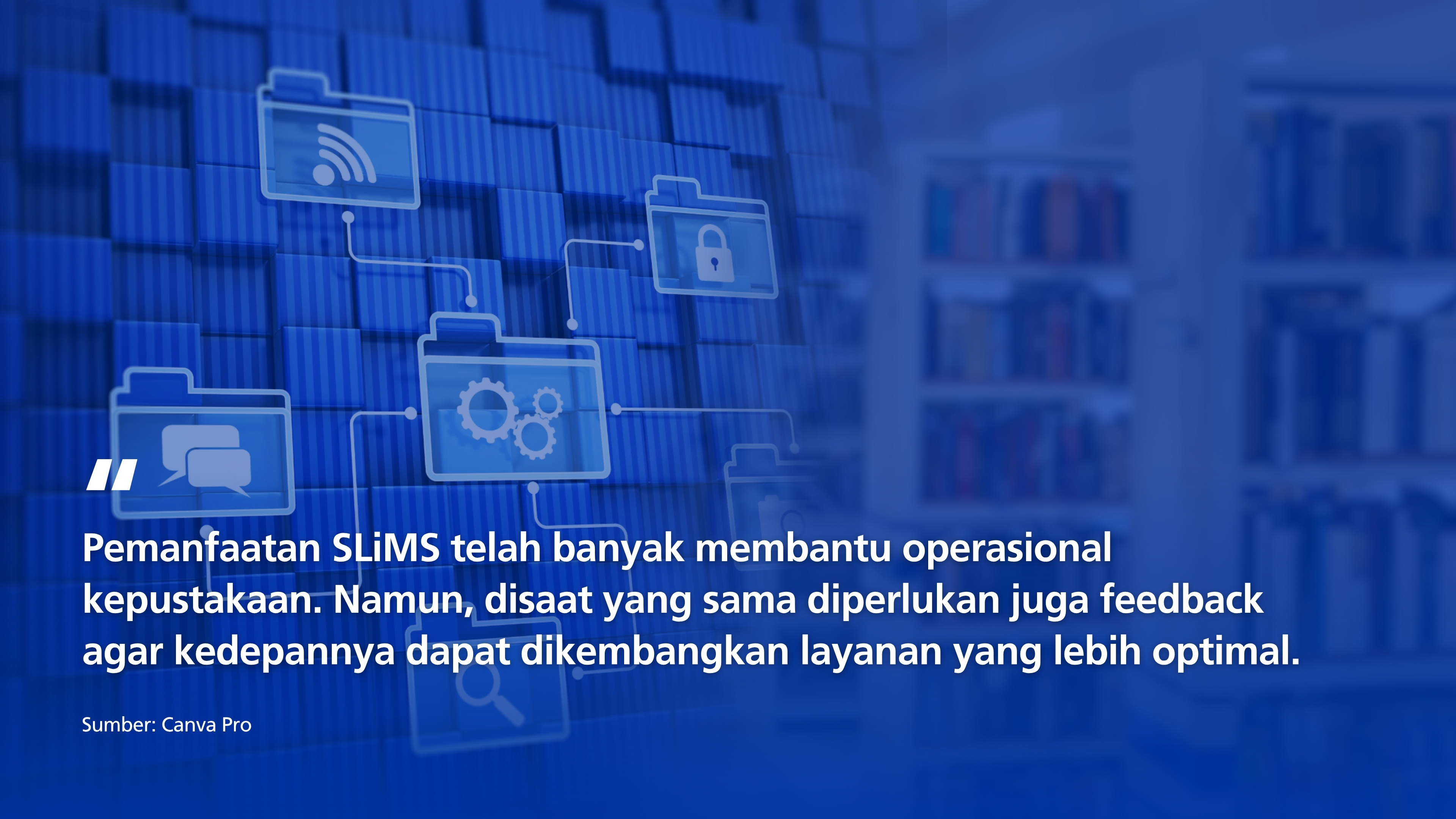
Known as one of the world's most revolutionary innovations, the internet has now become a primary necessity for various industrial sectors and society at large. The existence of the internet itself allows us to communicate without spatial and temporal boundaries.
Beyond its impact on the development of the communication sector, the internet now also plays a vital role in advancing the downstreaming of literacy and the information digitization process. As one of the sectors impacted by internet transformation, the library sector reaps the greatest benefits through the implementation of SLiMS.
SLiMS, or the Senayan Library Management System, is a web-based library management software widely used by the majority of libraries, both public and within educational institutions. The presence of SLiMS itself is considered highly beneficial in the library world. Its open-source nature allows libraries to manage collection circulation and supports overall operational performance.
As an active user of the SLiMS 9 Bulian management system, the Digital Library (Digilib) of Dian Nusantara University (UNDIRA) has integrated the use of SLiMS to facilitate accessibility and book recording based on biblio-rating values, enabling students to easily obtain quality information.
Nevertheless, user involvement remains a primary concern. The ease of accessibility for users is considered capable of sustainably supporting the long-term governance of the library management information system. Understanding this, Communication Studies lecturer and Head of the UNDIRA Library Bureau, Mr. Rengga Sendrian, M.Hum., conducted a satisfaction survey covering five categories of Digilib and SLiMS management aspects during the 2024/2025 academic year. This was based on the five foundations of EUCS (End-User Computing Satisfaction): content, accuracy, format, timeliness, and ease of use.
Furthermore, a Likert scale survey was utilized to establish benchmarks from 382 student respondents based on their thoughts and opinions regarding their experiences using the SLiMS 9-integrated Digilib. However, one of the main drawbacks of the Likert scale is its susceptibility to inconsistency or uncertainty, as respondents' answers may carry certain biases—even after being filtered through SPSS software.
Therefore, to enhance data credibility and consistency, the Cronbach's Alpha validation test method was selected to support the Likert scale survey responses. This is because Cronbach's Alpha is considered highly effective in representing consistency. The higher the value, the better the reliability of the data.
Following the data analysis and testing process of the 382 respondents, highly compelling results were obtained. A positive average result of 52.6% was achieved against satisfaction standards related to accessibility, interface implementation, as well as the availability of content and book collections. Conversely, the opposite trend was observed in terms of data presentation speed, which recorded a user dissatisfaction rate of 59%.
Overall, the results of this user satisfaction study serve as a tangible reflection that digital transformation in the library sector is not merely about technology adoption. Rather, it is about how the benefits of the technology are genuinely felt by its users while simultaneously providing room for future service growth.
The positive achievements in the aspects of ease of use and content accessibility indicate that the integration of SLiMS 9 Bulian in the UNDIRA Digilib is on the right track. On the other hand, the noted decline in the presentation speed aspect serves as a constructive signal that strongly reinforces the urgency for continuous evaluation.
Going forward, these EUCS data-driven findings are expected to serve as a strategic stepping stone for the UNDIRA Library and the UNDIRA community (Kawan UNDIRA) acting as users, in designing system updates that are more responsive, inclusive, and oriented towards user experience. Thus, the library will not only serve as a repository of information but also as an adaptive and relevant digital learning space for the entire academic community.
Source of Reference:
Press Contact :
Biro Humas & Sekretariat Universitas Dian Nusantara
Facebook : www.facebook.com/undiraofficial
Instagram : www.instagram.com/undiraofficial
Twitter : www.twitter.com/undiraofficial
www.undira.ac.id
Other
Often Misunderstood: Are All Radiation Dangerous? Read the Explanation Below
Read more
Intelligent Generation, Endless Innovation — Together We Give Quality Education for Our Civilization
Read more
A Smart Way to Predict Uncertainty and Manage Random Data: Understanding Monte Carlo Analysis
Read more
Campus Tanjung Duren
Jln. Tanjung Duren Barat II No. 1
Grogol, Jakarta Barat. 11470
Campus Green Ville
JIn. Mangga XIV No. 3
Campus Cibubur
Jln. Rawa Dolar 65
Jatiranggon Kec. Jatisampurna, Bekasi. 17432
Campus Cibubur Kranggan Raya
Jln. Raya Kranggan, No.6, RT 006/ RW 008
Jatiranggon Kec. Jatisampurna, Bekasi. 17432


